Tuesday, June 1, 2010

Fundraising Goal Reached!!

Fund raised: $3,000

I have no words to describe my appreciation today.  It would have never been possible without the support provided in all forms by those who have stepped forward to go the distance with me in this extraordinary endeavour. And I have been truly humbled most of all by your graciousness displayed simply as fellow human beings.

Again, thank you.

Terry Tsubota
2010 Reach The Summit Climber, Mt. Adams

Wednesday, May 19, 2010

Night Hike Training May 15th, 2010


This was another one of our big training events that we looked forward to. It was not so much about training for fitness but more about getting used to doing things in the dark under our headlamps such as doing gear checks, putting on/off the crampons, adjusting the boots, etc., since we will be summitting under similar conditions on our actual climbs. Tonight, we would start our "simulated" climb from the Timberline Lodge and go up about 1,500' to a mountaineering hut called Silcox Hut where we would turn around and come back down.

Some of us had decided to go up to the Timberline Lodge early to get few hours of naps in before the hike. By the time I finished work and managed to get on the road, it was already past 4pm and the traffic on the freeway had already come to an agonizingly slow crawl. It took me over two hours to get to the lodge where an hour would usually be enough. Though the plan was to join everybody at 6pm to have a dinner with them before the nap, this obviously was not going to happen at this point. So I decided that I would stop at Ice Axe, a beer and burger joint in the area, where I had a $12 Philly sandwich, fries and a glass of ice tea to wash them down.

When I got up to the Timberline Lodge's parking lot, the one end of its overnight parking section was lined with cars with climbers in them getting some Zs already. I was somewhat surprised by the number of cars but I probably shouldn't have considering Mt. Hood was the second most climbed mountain in the world (the first was Mt. Fuji in Japan.) I backed my car into an open parking space, made sure it was in gear so that it wouldn't start rolling by accident while I'm sleeping in it, and hopped out of it to go use the facility in the lodge.

As I was walking up the inclined parking lot, I saw Marty and Kristen coming down from the lodge to their car. The weather was crystal clear that night and the visibility was unlimited in all directions. I saw Mt. Jefferson to the south and Mt. Hood looked a lot bigger than usual.

Now the challenge was to create a little nook in my car where I would be able to unroll my sleeping bag and pad, not to mention myself. If you've ridden in a Jeep Liberty before, you probably can see how awkward this arrangement would be. The fact that I had so much junk in my car didn't help either. I folded down one of the rear seats' seat backs so that it would make a small area that somewhat resembled a reclining hospital bed, except that it was only about 5' long. However, once I got settled into my sleeping bag, it really wasn't as bad as I thought it would be. In fact it was surprisingly comfortable even though I was having to curl up in a fetus position in order to fit in the space I just created. Geoff, a friend I met through Reach The Summit program, was also pulling up next to my car as I was fussing with my napping space.

"Quack, quack quack! Quack, quack, quack! Quack, quack, quack! ..." My alarm clock was already... well... quacking. It didn't feel like I fell asleep at all but I must have - two hours went by as if it was merely 15 minutes. In an hour or so, we were to meet up with the rest of the climbers in the climber registration area and start our climb around midnight. Where's the nearest bathroom anyway??

After nursing a hot cup of strong Earl Grey, I was all decked out in mountaineering gear and ready to start the hike. We split into three different groups as usual but, this time, there was no particular category, such as a fast group, an intermediate group or an "endurance group" since it was going to be fairly a short hike. Once we completed this process, we headed out to the Timberline Trail that stretched pretty much straight up from there to Silcox Hut. In 10 minutes or so, we stopped to check our gear and to strap on our crampons. The temperature outside was a bit high at around 50 degrees and the snow felt heavy and mushy under our feet.

Then the usual and familiar slog started. Step by step we started our way up the foothill of Mt. Hood. There were lots of other groups on the trail as well. All probably aiming to summit. At one of our breaks, we turned off our torches to look up and admired the dizzying display of stars in the new moon. I wish I could have taken pictures of them but they wouldn't even resemble any sort of justice anyway.

The major difference between the training hikes we had been doing and this hike was that the snow was so soft and mushy that it was sort of like walking on the beach. The fact that the snowcats had been chewing up the trail earlier didn't exactly help either. We also stopped as often as necessary to practice making adjustments to our plastic mountaineering boots. I think almost all of us hated the plastic boots because it felt much like walking around in ski boots. Not that we had much other choices.

By the time we reached the level slightly above the Silcox Hut, we were roughly around 7,000 in elevation where we turned around and started going down. The gradient of the slope seemed to significantly increase from that point on and many of the groups continuing higher were putting their harnesses on to be ready for their eventual roped traveling.

Going down was much rougher than climbing up. The snow was completely chewed up by then by both the foot traffic and the snowcats making it difficult to make any step even close to decent. Mercifully, it took only about an hour or so to make our way down to the Timberline Lodge. By then, I was ready to head home and to squeeze in few hours of Zs before I had to head back out for the volunteer activities I promised to attend that day. What a hike!!

As if this was not enough this weekend, our next hike is scheduled tomorrow, a day after this night hike, at Nesmith Point in the Columbia River Gorge. This will be our longest and toughest hike yet with the vertical elevation gain of 3,800 over a distance of 10 miles round trip. Stay tuned!!

Friday, May 7, 2010

10th Training Hike - Dog Mountain May 8th, 2010


The location for this lung and quad burning session was changed to Dog Mountain due to the winter like condition in the Mt. Hood area.


Under the crystal clear sky that would warm us up in its 70 degrees air today, we sucked it up and started pounding the trail that launched steeply via a series of switch backs until we reached a split in the trail where, once again, it offered us a choice between "More Difficult" and "Less Difficult." At glance, it would be somewhat deceiving to first-timers as the "More Difficult" trail continued from that point with a short flat section while the other one climbed on. I'm sure you can guess by now which way we went.


Jason led my group, the intermediate group, with good spirit. From the beginning, he did a great job of reminding us about the abundance of poison oak on both sides of the trail whenever we made brief stops to adjust our gear, etc. We were also very wary of any dog dragging a hiker as it most likely had been going in and out of the poison oak bushes and looking for some victims to brush up against.


Since we had been on this trail before on one of our training hikes, we were more zoned into the task of climbing than the last time and not getting distracted by the gorgeous scenery, I think. Not that that was much possible at the pace we were going. I was actually hoping to see a knoll covered by spring flowers as we broke out of the wooded section but it was obviously premature despite the warm weather today. There were some flowers blooming but not to the extent Dog Mountain was known for.


But we thoroughly enjoyed the panoramic view of the Columbia River Gorge while we devoured our feed at the summit. Especially after beating the time from our last hike here by 15 minutes, at 1:45 to slither up from the trail head to the top, gaining 2850' in elevation. That's 1,629'/hour!


Now the only carrots hanging in front of our noses were the nice tall cold ones down at Edgefield which had become our regular hang-out in this area. We were thankful that we started our hike early enough in the morning before the temperature shot up to bake anyone going up that south facing trail. It also helped that we descended via the "Less Difficult" trail flanked on the shadier side of Dog Mountain. About a half way down the mountain, we found Jennifer, Abby and Hilary sitting at a nice little trail side bench enjoying their lunches.


Edgefield was packed with weekend warriors and alike outside. Every single table was taken so we planted ourselves on the lawn just behind a huge water tower. The cool grass felt great after the rigorous exercises. Our waitress was nice enough to accommodate us there for much needed beverages and even some real food. Couldn't get much better than that!

Now that our climb dates are getting closer, we will be going back to Mt. Hood next weekend to get some night hike time under our belts. We will start climbing around midnight from Timberline Lodge to Silcox Hut where the Mt. Hood climbers will be spending a night just before their summit. Stay tuned!!

Sunday, May 2, 2010

8th Training Hike - Tilly Jane April 24th, 2010

With only few hours of sleep after a rough night out in town, I once again whipped myself out of my bed at 5:15am to strap on a backpack. It's going to be a looooooooong day today - I had a fundraiser event that I promised to go to after the hike too!!!


It was rather a long drive to the trail head. I was thankful that I did not have to drive that morning. The trail head was located on the east side of Mt. Hood right next to Cooper Spur Sno-Park. Marty had a flat tire on his way up so we waited a little while until he and his occupants rolled into the parking lot. Today, I decided to join the "endurance" group to mingle with them as I had been hiking in the intermediate group on most of our hikes.


Tilly Jane Trail would take us way into Mt. Hood's alpine backcountry via a 3.5 miles trail that ascended 2,000' until we eventually arrived at Cloud Cap Inn. This Inn was originally built in 1889 as a resort for tourists with lots of money. Today, it serves as a headquarter for Crag Rats Alpine Club that offers itself as a mountain rescue group when needed.


This hike was originally meant to be a snowshoeing trip. And, as far as we could see, it looked like the trail was going to be kind of icy so we strapped on our snowshoes from the outset. However the snow/ice on the trail vanished only after few hundred feet or so and we were forced to take off the snowshoe to lash them back on our backpacks.


Because the temperature was in the mid 40s already, the run off from the snow was making the trail quite muddy and slippery in some parts. We meandered through the woods typical of the northwest dominated by the evergreens for the first half of the hike. I felt unexpectedly well once we were on our way up the trail despite how tired I was feeling at the meetup point earlier. As we ascended through the woody area, we found ourselves walking through a section that was charred by a fire few years ago. Some of the burnt trees looked quite interesting - only the burnt outer parts of the trunks remained standing while their cores had relented to decay.


We were starting to see some snow again on the trail as we gained elevation. The snow base thickened exponentially once we crossed the freezing level and the training we had last week at the Climbers Clinic came in pretty handy particularly in sections that required us to traverse. Matt who was leading our group reminded us how to edge our boots in order to make more secure steps. But some parts were just too icy to get any boot penetration - I wished I had my crampons with me, which I left in the back of my car! Though we had snowshoes, Matt elected not to have us put them on as they in fact would have made it even more precarious in such conditions. In some other parts, I kept sinking into the snow up to my knees every other step as I put full weight on the foot, making it rather laborious to keep marching.


We enjoyed chewing our lunches in an A-frame shelter at the Tilly Jane campground. It was a quintessential alpine log cabin on one of Mt. Hood's ridges that housed a wood burning stove, tables and benches inside among other odds and ends. From there, our final destination, Cloud Cap Inn, was only a half an hour away. By the time our group arrived there, the fast group was already getting ready to start their final push. Their leader, Marty, organized his climbers into two groups, a group of people who wished to continue up to the Inn and another of those who opted to call it a day and to head down. Because we carpooled from the meetup point to the trail head, there was some logistical issues that needed to be taken into consideration as well.


All members of the "endurance" group were all for going up to Cloud Cap Inn. I was actually feeling very good at this point. It had crossed my mind that maybe I was being mildly hypoxic even though we were only around 5,500' in elevation - euphoria was one of the first sign of hypoxia in general. And the more I thought about it, the more sense it made, taking into account my lack of sleep, high level of physical activity, etc., etc.


As soon as we departed the shelter, we went down a steep ravine to cross a snow bridge across a creek (Tilly Jane Creek?) one by one. By this point, the base of the snow was about a dozen feet and we certainly didn't need to risk collapsing the bridge. There was no visible trail in particular so Matt plowed ahead stomping new steps along the way. Indeed after about a half an hour or so, we popped up on another ridge where Cloud Cap Inn stood.


And what a gorgeous view it had! we were awarded with the panoramic view of Mt. Hood's eastern foothill. Even better than that, the rocky top half of Mt. Hood showed itself as a veil of clouds flirted with its undeniable existence. In less than a couple of months, many of us will be setting foot on the summit of this very mountain. That was pretty awesome even just to think about. As we milled around taking pictures, etc., a flurry of snow started to whirl around us. In order to avoid getting caught in an unexpected weather, we started descending by reversing our path. In some ways, descending was not much easier than climbing up as we still needed to keep ourselves focused traversing the sections we struggled on earlier and to pay close attention on our footings despite the fatigue that was starting to set in all of us.


Sadly, I am not going to be able to join the Salmon Butte hike next weekend. I hope everyone will have a great one. Take lots of pictures!

Monday, April 26, 2010

Climbers Clinic - Mt. Hood April 17th, 2010

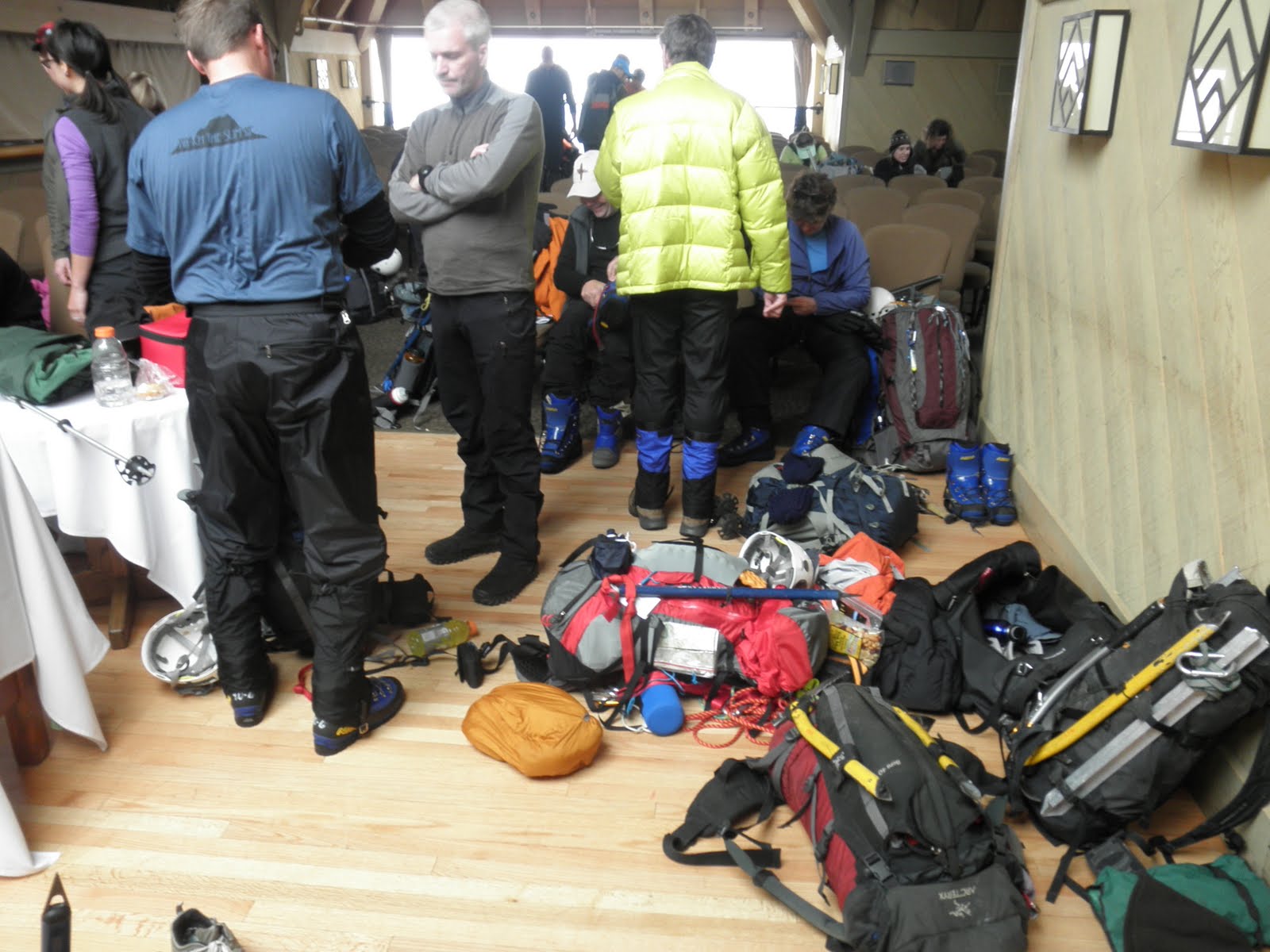
Many of us had been looking forward to our Climbers Clinic ever since we joined the Reach The Summit program few months ago. We had been doing lots of training since then but this was the first time we had a chance to interact with the guides from the Timberline Mountain Guides and to do some mountaineering stuff! We gathered today in a conference room at the historic Timberline Lodge to meet up with the guides who would be instructing us on the basic mountaineering skills.


In the email distributed prior to the clinic, they told us to bring all the gear we have so far that we would use on our actual climb. And everything we brought. I had a 65 litter pack but I ended up using every cubic centimeters of it to fit all the gear in it:

• Backpack - Osprey Atmos 65
• Pack cover - Gregory
• Sleeping bag - Mont Bell UL Super Stretch #1 (15 degrees F)
• Sleeping pad - Therm-A-Rest Toughskin Regular
• Balaclava - Fleece
• Fleece hat - Mountain Hardware
• 3 pairs of Gloves - Heavy warm gloves, Medium weight fleece gloves, and a glove liner
• Snow shovel - Black Diamond D7
• Ice Axe, 70cm - REI (made by Grivel), rented from REI
• Crampons - 12 points, semi flexible, stepin type with horizontal front points, rented from REI
• Climbing helmet - Petzl Ecrin Roc, rented from REI
• Map
• Compass
• Knife
• Small shovel for digging cat holes, etc.
• TP
• A small baggy containing odds and ends such as batteries, band-aids, accessory cords, matches, a lighter, mole skins, an emergency "blanket", a pen and a waterproof pad, etc.
• Packable towel - MSR
• A flask of whiskey
• First aid kit
• A bag of food
• Small cooking pot - Snow Peak titanium
• Insulated mug/cup
• Stove - Brunton
• Stove fuel
• 2 1q containers of water
• Extra cloths, long underwear (top and bottom), underwear, pants
• Outer shells - REI rain pants and Columbia jacket
• Warm insulating jacket: Columbia down jacket - borrowed from Jennifer today
• An assortment of carabiners
• Climbing harness - Black Diamond Blizzard
• An Assortment of runners/slings - 5 singles, 3 doubles, and 2 triples made of 1" webbings
• Prusik cords made of 7mm accessory cords
• Pulley
• Head lamp
• Waterproof notepad & pencil
• Glacier glasses
• Snow goggles
• Fire starter

I'm sure I missed few things but the total weight came to about 45 pounds or so. On the actual day of climb, after adding food, pieces of tents, etc., it might top 55lbs.


As we settled in the conference room, Mat was the first guide to introduce himself and talk to us. He had been a mountain guide for about ten years and he had been volunteering every year for the Reach The Summit program to train and guide the climbers. Soon, Joe, the guide who would be guiding my group climbing Mt. Adams, joined us.


Joe started by laying out few of the concepts that went into mountaineering. One reason why I have enjoyed mountaineering, I think, is because it requires the thought processes that are very similar to those in aviation (I'm a professional pilot by trade.) That might sound complicated but it really isn't. To me, the issue is pretty simple whether I'm climbing a mountain or flying an airplane, though it takes practice to get in a habit of thinking in this term - it is all about not getting yourself cornered into a situation you cannot get out of and making sure that you always have a way out (preferably more than one, actually.) I really enjoy putting together all the elements that goes into climbing mountains, from the initial planning to the actual climb and the descent. Not to mention the Plan Bs.


For example, Joe stressed the importance of keeping the exposure low while maintaining the control high when we are on the mountain. And that in fact it would be one of the guides' primary roles on our trips. The topic of conserving energy in order to maintain high level of reserve was another one. He pointed out the differences between cycling with his friends and climbing mountains with his friends as an example. When bicycling, Joe would go fast uphill so that he could savor the sight of the pain in his friend's face struggling to keep up with him. However, on the mountains, it would be the opposite extreme. On the mountains, he would like to make sure that his climbing partners are well taken care of so that they would be able to take care of him as well.


He talked a little about the equipment unique to mountaineering such as helmets, ice axes, crampons, and mountaineering boots, emphasizing particularly the importance of being cognizant of the sharp parts that could cause injuries if one was not being careful, like sitting on the pack with the crampons strapped on it. He also showed us how to carry the ice axes on our packs, a trick on how to carry the crampons, etc.


Then it was time for Jennifer to split us into three groups. Joe led the group that would be climbing Mt. Adams plus Charles who would be climbing Mt. Hood. Jennifer took the "girl power" group's helm. And Mat took charge of the rest. Once this task was completed, it was time to have our gear inspected by our respective leaders.


When my turn came, I dumped everything out on the floor and Joe looked at them one by one. He seemed mostly happy with what I had. Particularly my whiskey flask. About the only thing he mentioned was that I would not need to bring any of my webbings, pullies, carabiners, Prusik cords, etc. as each guide would be carrying a set. However, he also left it kind of up to me. I have not decided yet but I think I will probably carry a minimal set of things at least anyway. It's sort of a security blanket thing for me - I remember there were more than one occasions in my past when I wished I had certain equipment with me that I didn't take with me. They wouldn't do any good just hanging in my closet for sure. Joe also showed me how to tie cords and webbings into small bundles to keep them from flapping around in the wind.


Once our gear inspections were complete, we put on our plastic mountaineering boots and headed out to meet back up by the training ground. I remember when plastic boots were just starting to become popular in Japan. The first double mountaineering boots I had had leather outer shell, actually. Plastic boots are well suited for snow/glacier travels in very cold temperatures as they are very stiff soled and your digits would be well preserved in the dry, toasty warm inner boots. They are not particularly suited for more technical stuff like trips involving rock/ice climbing because they do not give you very good feels for what's underneath your feet. It kind of feels like you're walking around in ski boots actually. On such occasions, leather or synthetic single boots typically work better. If you need warm boots for technical trips, nowadays you can actually find boots that are compromise between the plastic and the leather/synthetic kinds.

We marched out to the bottom of a small gully next to the Timberline Lodge's overflow parking lot where we could practice safely. The snow was very soft, loose and heavy as my thermometer was threatening to shoot past 60 degrees. Joe had explained to us earlier what boot penetration meant, which basically was the measurements of how far your boot would sink into snow as you put your full weight on your foot each step. The boot penetration was probably nearly two feet or so in some sections.

From there on, we spent few hours learning and practicing various basic steps that are used in mountaineering such as kick steps, duck steps, traversing, climbing/descending in balance, plunge steps, etc. Mushy snow made it more difficult but the conditions in the warmer section of our actual climb probably is going to be similar anyway.


Now that we knew how to maneuver in snow, we strapped on our crampons to try some of the same steps we just learned. It felt much more secure as my feet would not slide each time I took a step. I was thankful that our crampons came with antiballing plates that prevented snow from sticking to the bottom our feet. Without them we would have been turning into a bunch of snow balls ourselves in a condition like this.


Then it was time to play with our ice axes. Joe explained what each part was and how it worked. He demonstrated the two ways to hold the head, the self belay mode and the self arrest mode. There were two schools of thoughts in general as to the uses of leashes on them. One was that a leash would prevent you from loosing the ice axe in the mountain and also it could function as a self belay clipped into your harness. The draw backs were that the ice axe could become a hazard in the event of a fall if you lose the grip on it and also that it could become a source of entanglement as we switched hands back and forth while roped. In general, I guess it's a judgement call but, as a matter of the Timberline Mountain Guides' policy, we were told not to use our leashes on our ice axes. Once again, we practiced climbing, descending and traversing using the steps we have learned already with our ice axes held in the cane position and the stake position.


Now the last item on our syllabus for the day. With Josh, Marty, and Heather's help, Joe briefly demonstrated how we might be climbing roped up together on the mountains. Joe showed us the equipment such as the rope and the carabiners and how they worked. Once Josh, Marty and Heather strapped themselves up in their harnesses, they tied into the rope with Joe in the lead to demonstrate how a group of climbers would proceed without belay, with running belays, or with a quick belay. In the middle of all that, a dog showed up from nowhere and poked his head over the edge of the practice slope, obviously amused by the sight of people tied to a rope for a change..


Next week, we will be coming back to the foothill of Mt. Hood on the east side of the mountain this time to get more experience in climbing in snow. With a little cooperation from the weather, we might even get a closer look at the top half of Mt. Hood where many of us will be climbing in a couple of months. Stay tuned!!!

Tuesday, April 13, 2010

7th Training Hike - Dog Mountain

Now that my taxes have been signed, sealed and delivered, I can get back to more important stuff now!


Much anticipated Dog Mountain hike took place in wonderful gentle sunny weather with the temperature starting in the mid 50s in the morning. Many of us looked forward to this hike because of its reputation for the views from the top that any photographer would die for.


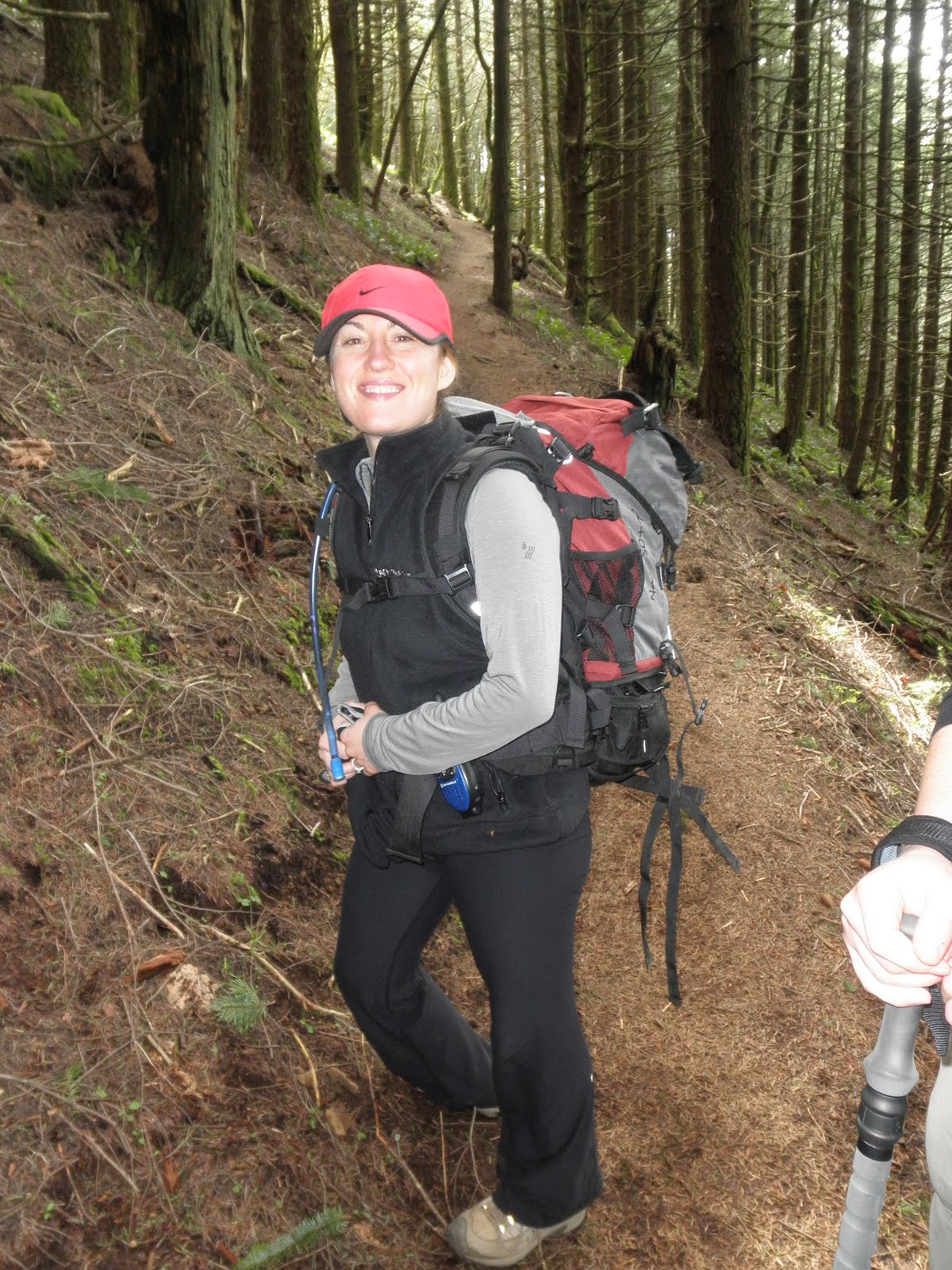
Once again, with my pack loaded to 35lbs, I joined the intermediate group led by our training leader, Kelly. From the large parking area, the trail began steeply. In several minutes into the hike, I tried to take a sip of water from my hydration tube when I realized that there was no water coming out! I thought perhaps the mouth piece was malfunctioning so I dug out the spare mouth piece and replaced it during our gear check break. Ugh, still no water!! Luckily the problem was pretty simple - somehow the tube got twisted when I put it in my back pack the night before. Thank goodness!! Though I had another bladder of water in my pack as a weight, it would have been a major hassle if I had to use that.


After gaining about 700' already in the first 1/2 mile, we came to a fork in the trail. There was a Roadrunner cartoon style sign post with two planks of wood nailed to it. One read "More difficult" that pointed to the left, and the other "Less difficult" etched on to it. Both trails before us would lead to the top after 2850 ft of elevation gain. On normal hikes, your choice would be dictated by whether you liked pain in your lungs better than in your knees or vice versa.


On any Reach The Summit hike, there was only one choice for us by default. The left fork climbed steeply up the northern flank of the mountain (the brown dotted line) with only few brief, relatively flatter sections. Though I felt like my level of fitness has regressed somewhat in the past couple of weeks as I had not been able to do much of physical exercises during that time due to some family stuff going on, I was actually surprised by how quickly we ascended this steep mountain.


After an hour and fifteen minutes or so of pounding this wickedly steep trail, we were already popping out of the woods and were rewarded by the incredible panoramic view of the Columbia River Gorge as we emerged into the summit meadows. In fact, the view was so amazing to the point of distraction that I really had to remind myself from time to time to bring my focus back to the task of climbing at hand. At this point, we had only another 500' in elevation to go to get to the summit.


We enjoyed our lunch sitting near a small patch of snow. Mt. Hood (left) was showing off its gnarly summit blanketed in clouds behind the Gorge. Mt. St. Helens (right) was probably the most prominent of all - even though its east half had been blown off by its last eruption, it exerted its massive presence. I almost missed Mt. Adams (left) as it was sort of hidden behind the trees from where we were sitting. I couldn't wait to set my foot on it this August!


Mercifully, we descended via the "Less difficult" route that took us to the east side of the mountain that was supposed to give us a little break from having to jack hammer the dirt with our poor knees. Notice I said "was supposed to". As tough as going up was on our quads, going down was torturous to say the least. But it's true, though, that the most important part of climbing is the going down part. I was at one of the REI's seminar, "Climbing the Cascades," last night and the guy who threw the talk put it best: "The best place to be on any mountaineering trip is the parking lot."


This weekend, we are going to have tons of fun at Mt. Hood!! The guides from the Timberline Mountain Guides, who are volunteering to provide us with the technical training and guide services, are going to spend all day giving us instructions on basic mountaineering techniques. Stay tuned!!


Monday, April 12, 2010

Early Bird Special Contest Winner


And the Winner Is.... Click Here

Friday, April 2, 2010

non-RTS Training Hike - Saddle Mountain

April 2nd, 2010


Today's training hike to Saddle Mountain was postponed to 4/5 (Mon) due to hazardous weather in the area.

Stay tuned!!


April 5th, 2010

WOW, what a hike we had today!!! I was really itching to do something since I had not had a chance to hike at all for the past couple of weeks due a series of family events. On top of that, our postponing this hike due to the storm this past Friday had added to my itch like poison oak rubbing on already a raw spot.


Geoff, Charles and I met up at Target at the usual time this morning to hike Saddle Mountain. It was raining lightly when we left the Target's parking lot about 8am or so. The trail head was located about 10 miles inland from the coast near the highway 26 that ran westward from Portland. We started to see some traces of snow on the ground just as I made a remark about how we were lucky that we did not to see any snow when we were passing the 1,000' elevation marker. After driving for about an hour, we turned off onto a paved road that took us north for about another 7 miles to the trail head. After about a half way into this road, an awesome view of Saddle Mountain all of sudden appeared through the beautiful evergreen trees as we came around a curve in the road. We were the only ones in the parking lot.

So the plan was sort of to follow the regular regiment, i.e. to take a gear check break after the first 20 minutes and a break every 45 minutes or so thereafter. All three of us were dressed in layers with full rain garments that gave us protections from the elements. The trail on Saddle Mountain stretched only about 2.5 miles to the top but it gained respectable 1,700' in elevation altogether.


It was amazing how much I could go out of shape in a matter of a couple weeks though. I struggled to maintain a decent pace until we took our gear check break. But then it got much easier from there on. I guess my body needed a little jump start to get going again.


We started to see gradual increase in snow accumulation as we ascended through the wood. Little did we know that we were about to walk into a blizzard and near white out condition as we got above the tree line. The wind was blowing furiously up the side of the mountain and the trail had completely disappeared under two feet of snow in front of us. We could barely make out where it used to be.


We were at the decision point. After few minutes of observing and discussing, we decided to proceed another few hundred feet or so to see if the condition on the other side of this section would be better, or at least good enough to go further. Don't ask us why but there we went.

Where were the goggles when we needed them anyway?? We might as well have stuck our heads in front of a sand blaster actually. The wind mercilessly drove ice pellets into us like machine guns. Any exposed portion of our skin got thoroughly exfoliated in the process and, by the time we got to the other side of this section and took refuge behind a lone evergreen tree, there was no doubt in our minds that we were at the end of our little adventure for the day. Not to mention the fact that we were starting to follow a false trail (right) that led off a cliff. Great!!


After a few Kodak moments taking pictures of each other for the record, we turned around and reversed our direction to trace our foot prints back to the beginning of this section where the trees would give us some protection. To our amazement, our foot prints were almost completely gone. They had been blown over by the wind and snow to the point where we could barely see them in a matter of five to ten minutes. We proceeded step by step VERY CAREFULLY so as not to end up sliding down into an oblivion.


Even after we were back under the trees' protection, snow had accumulated as much as about a foot or so on the trail and we had to be very cautious about our footings on our descent. But the sights were gorgeous in sort of surreal ways. On one of the sections, the snow covered tree branches formed a tunnel like path for us to walk through. I had always loved hiking in snow despite its unique challenges. About a half way down the mountain, we saw another set of foot prints leading down the trail. There must have been somebody set off on a hike but decided to turn around and go back. Smart!


I had always wanted to check out Camp 18 Restaurant on highway 26 which had a lot of memorabilia from the old days in the logging industry on display in a log cabin style structure. I finally got my chance on our way back when we stopped there for a lunch. We were in awe of the purely enormous sizes of everything, such as the chain saws that were at least 10 feet in length with handles on both ends, the bar counter downstairs made of a wood slab at least two feet thick and twenty feet long, and the front register carved out of a tree stump several feet in diameter. Pretty cool.

Thursday, April 1, 2010

Climbers ascend Mount Hood in memory of woman

This article appeared on a Butte, MT paper on 3/9/10. (Click here for the link to the article.)


In 2005, Cathy Davis was a healthy wife and mother, a Boeing employee who had recently been promoted to a new position in China.

The wife of Butte resident Tom Davis, Cathy ate healthy, exercised and never smoked. And she never suspected the nagging back pain she suffered could be lung cancer.

But four months later, Davis fell victim to one of the deadliest cancers in the country, one which killed more than 160,000 Americans last year.

"It really came out of nowhere," said Tom Davis, a 1984 graduate of Butte Central, in a phone interview with The Montana Standard. "By the time Cathy knew she had it, it was too late." Tom and Cathy met at Carroll College in Helena, where she was a star athlete. They moved to Oregon, then Seattle and then to Beijing. It was there that she got sick.

For Tom it was a tough introduction to the disease, one that carries a taboo when it comes to fundraising and research efforts.

"There is this feeling like you did it to yourself, or it's your fault if you have lung cancer. Cathy never did anything, she never smoked, she ate healthy, she was very active," said Tom.

It's in memory of people like Cathy that the American Lung Association started its "Reach the Summit" program, which trains people in mountain climbing. The program includes guided trips to the summit of Mount Hood in Oregon, Mount Adams in Washington State, the Grand Tetons in Wyoming, and summits in Ecuador, including the Cayambe volcano. The climbers all raise money for the association.

Patty Unfred, of Oregon, Cathy's sister, ascended Mount Hood in 2008 as a way to honor and stay connected to her sister.

"It's hard to make sense of this kind of stuff," said Unfred. "This was a way for me to feel close to her." It wasn't something that she could imagine herself doing.

"Cathy was the athlete, not me," Unfred said with a laugh.

But she persevered with the help of her climbing group, and since conquering Mount Hood she's been motivated to continue the sport on her own.

"It really inspired me," said Unfred. "It's become a passion of mine." Alison James, Helena, development manager for the lung association's Montana and Wyoming branch, said they are still looking for people to take part in the program.

"It's a really cool adventure," said James. "Most people who join with us have never climbed before, and we will be doing a lot of training as a group." The climbs occur from June through December. The climbers are asked to raise money to take part, from $3,000 for Mount Hood to $10,000 for the South America trip.