Monday, April 26, 2010

Climbers Clinic - Mt. Hood April 17th, 2010

Many of us had been looking forward to our Climbers Clinic ever since we joined the Reach The Summit program few months ago. We had been doing lots of training since then but this was the first time we had a chance to interact with the guides from the Timberline Mountain Guides and to do some mountaineering stuff! We gathered today in a conference room at the historic Timberline Lodge to meet up with the guides who would be instructing us on the basic mountaineering skills.


In the email distributed prior to the clinic, they told us to bring all the gear we have so far that we would use on our actual climb. And everything we brought. I had a 65 litter pack but I ended up using every cubic centimeters of it to fit all the gear in it:

• Backpack - Osprey Atmos 65
• Pack cover - Gregory
• Sleeping bag - Mont Bell UL Super Stretch #1 (15 degrees F)
• Sleeping pad - Therm-A-Rest Toughskin Regular
• Balaclava - Fleece
• Fleece hat - Mountain Hardware
• 3 pairs of Gloves - Heavy warm gloves, Medium weight fleece gloves, and a glove liner
• Snow shovel - Black Diamond D7
• Ice Axe, 70cm - REI (made by Grivel), rented from REI
• Crampons - 12 points, semi flexible, stepin type with horizontal front points, rented from REI
• Climbing helmet - Petzl Ecrin Roc, rented from REI
• Map
• Compass
• Knife
• Small shovel for digging cat holes, etc.
• TP
• A small baggy containing odds and ends such as batteries, band-aids, accessory cords, matches, a lighter, mole skins, an emergency "blanket", a pen and a waterproof pad, etc.
• Packable towel - MSR
• A flask of whiskey
• First aid kit
• A bag of food
• Small cooking pot - Snow Peak titanium
• Insulated mug/cup
• Stove - Brunton
• Stove fuel
• 2 1q containers of water
• Extra cloths, long underwear (top and bottom), underwear, pants
• Outer shells - REI rain pants and Columbia jacket
• Warm insulating jacket: Columbia down jacket - borrowed from Jennifer today
• An assortment of carabiners
• Climbing harness - Black Diamond Blizzard
• An Assortment of runners/slings - 5 singles, 3 doubles, and 2 triples made of 1" webbings
• Prusik cords made of 7mm accessory cords
• Pulley
• Head lamp
• Waterproof notepad & pencil
• Glacier glasses
• Snow goggles
• Fire starter

I'm sure I missed few things but the total weight came to about 45 pounds or so. On the actual day of climb, after adding food, pieces of tents, etc., it might top 55lbs.


As we settled in the conference room, Mat was the first guide to introduce himself and talk to us. He had been a mountain guide for about ten years and he had been volunteering every year for the Reach The Summit program to train and guide the climbers. Soon, Joe, the guide who would be guiding my group climbing Mt. Adams, joined us.


Joe started by laying out few of the concepts that went into mountaineering. One reason why I have enjoyed mountaineering, I think, is because it requires the thought processes that are very similar to those in aviation (I'm a professional pilot by trade.) That might sound complicated but it really isn't. To me, the issue is pretty simple whether I'm climbing a mountain or flying an airplane, though it takes practice to get in a habit of thinking in this term - it is all about not getting yourself cornered into a situation you cannot get out of and making sure that you always have a way out (preferably more than one, actually.) I really enjoy putting together all the elements that goes into climbing mountains, from the initial planning to the actual climb and the descent. Not to mention the Plan Bs.


For example, Joe stressed the importance of keeping the exposure low while maintaining the control high when we are on the mountain. And that in fact it would be one of the guides' primary roles on our trips. The topic of conserving energy in order to maintain high level of reserve was another one. He pointed out the differences between cycling with his friends and climbing mountains with his friends as an example. When bicycling, Joe would go fast uphill so that he could savor the sight of the pain in his friend's face struggling to keep up with him. However, on the mountains, it would be the opposite extreme. On the mountains, he would like to make sure that his climbing partners are well taken care of so that they would be able to take care of him as well.


He talked a little about the equipment unique to mountaineering such as helmets, ice axes, crampons, and mountaineering boots, emphasizing particularly the importance of being cognizant of the sharp parts that could cause injuries if one was not being careful, like sitting on the pack with the crampons strapped on it. He also showed us how to carry the ice axes on our packs, a trick on how to carry the crampons, etc.


Then it was time for Jennifer to split us into three groups. Joe led the group that would be climbing Mt. Adams plus Charles who would be climbing Mt. Hood. Jennifer took the "girl power" group's helm. And Mat took charge of the rest. Once this task was completed, it was time to have our gear inspected by our respective leaders.
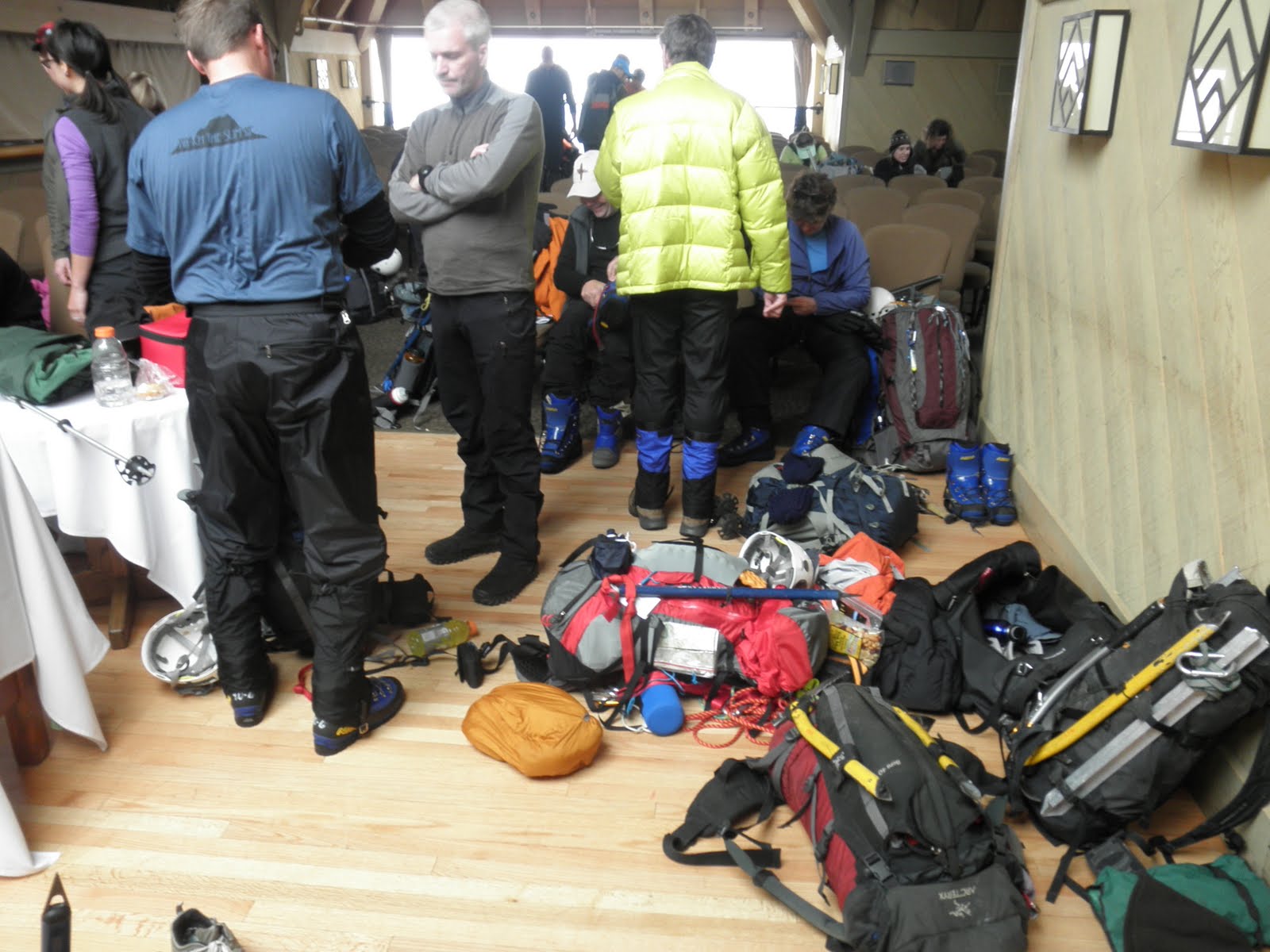

When my turn came, I dumped everything out on the floor and Joe looked at them one by one. He seemed mostly happy with what I had. Particularly my whiskey flask. About the only thing he mentioned was that I would not need to bring any of my webbings, pullies, carabiners, Prusik cords, etc. as each guide would be carrying a set. However, he also left it kind of up to me. I have not decided yet but I think I will probably carry a minimal set of things at least anyway. It's sort of a security blanket thing for me - I remember there were more than one occasions in my past when I wished I had certain equipment with me that I didn't take with me. They wouldn't do any good just hanging in my closet for sure. Joe also showed me how to tie cords and webbings into small bundles to keep them from flapping around in the wind.


Once our gear inspections were complete, we put on our plastic mountaineering boots and headed out to meet back up by the training ground. I remember when plastic boots were just starting to become popular in Japan. The first double mountaineering boots I had had leather outer shell, actually. Plastic boots are well suited for snow/glacier travels in very cold temperatures as they are very stiff soled and your digits would be well preserved in the dry, toasty warm inner boots. They are not particularly suited for more technical stuff like trips involving rock/ice climbing because they do not give you very good feels for what's underneath your feet. It kind of feels like you're walking around in ski boots actually. On such occasions, leather or synthetic single boots typically work better. If you need warm boots for technical trips, nowadays you can actually find boots that are compromise between the plastic and the leather/synthetic kinds.

We marched out to the bottom of a small gully next to the Timberline Lodge's overflow parking lot where we could practice safely. The snow was very soft, loose and heavy as my thermometer was threatening to shoot past 60 degrees. Joe had explained to us earlier what boot penetration meant, which basically was the measurements of how far your boot would sink into snow as you put your full weight on your foot each step. The boot penetration was probably nearly two feet or so in some sections.

From there on, we spent few hours learning and practicing various basic steps that are used in mountaineering such as kick steps, duck steps, traversing, climbing/descending in balance, plunge steps, etc. Mushy snow made it more difficult but the conditions in the warmer section of our actual climb probably is going to be similar anyway.


Now that we knew how to maneuver in snow, we strapped on our crampons to try some of the same steps we just learned. It felt much more secure as my feet would not slide each time I took a step. I was thankful that our crampons came with antiballing plates that prevented snow from sticking to the bottom our feet. Without them we would have been turning into a bunch of snow balls ourselves in a condition like this.


Then it was time to play with our ice axes. Joe explained what each part was and how it worked. He demonstrated the two ways to hold the head, the self belay mode and the self arrest mode. There were two schools of thoughts in general as to the uses of leashes on them. One was that a leash would prevent you from loosing the ice axe in the mountain and also it could function as a self belay clipped into your harness. The draw backs were that the ice axe could become a hazard in the event of a fall if you lose the grip on it and also that it could become a source of entanglement as we switched hands back and forth while roped. In general, I guess it's a judgement call but, as a matter of the Timberline Mountain Guides' policy, we were told not to use our leashes on our ice axes. Once again, we practiced climbing, descending and traversing using the steps we have learned already with our ice axes held in the cane position and the stake position.


Now the last item on our syllabus for the day. With Josh, Marty, and Heather's help, Joe briefly demonstrated how we might be climbing roped up together on the mountains. Joe showed us the equipment such as the rope and the carabiners and how they worked. Once Josh, Marty and Heather strapped themselves up in their harnesses, they tied into the rope with Joe in the lead to demonstrate how a group of climbers would proceed without belay, with running belays, or with a quick belay. In the middle of all that, a dog showed up from nowhere and poked his head over the edge of the practice slope, obviously amused by the sight of people tied to a rope for a change..


Next week, we will be coming back to the foothill of Mt. Hood on the east side of the mountain this time to get more experience in climbing in snow. With a little cooperation from the weather, we might even get a closer look at the top half of Mt. Hood where many of us will be climbing in a couple of months. Stay tuned!!!

Tuesday, April 13, 2010

7th Training Hike - Dog Mountain

Now that my taxes have been signed, sealed and delivered, I can get back to more important stuff now!


Much anticipated Dog Mountain hike took place in wonderful gentle sunny weather with the temperature starting in the mid 50s in the morning. Many of us looked forward to this hike because of its reputation for the views from the top that any photographer would die for.


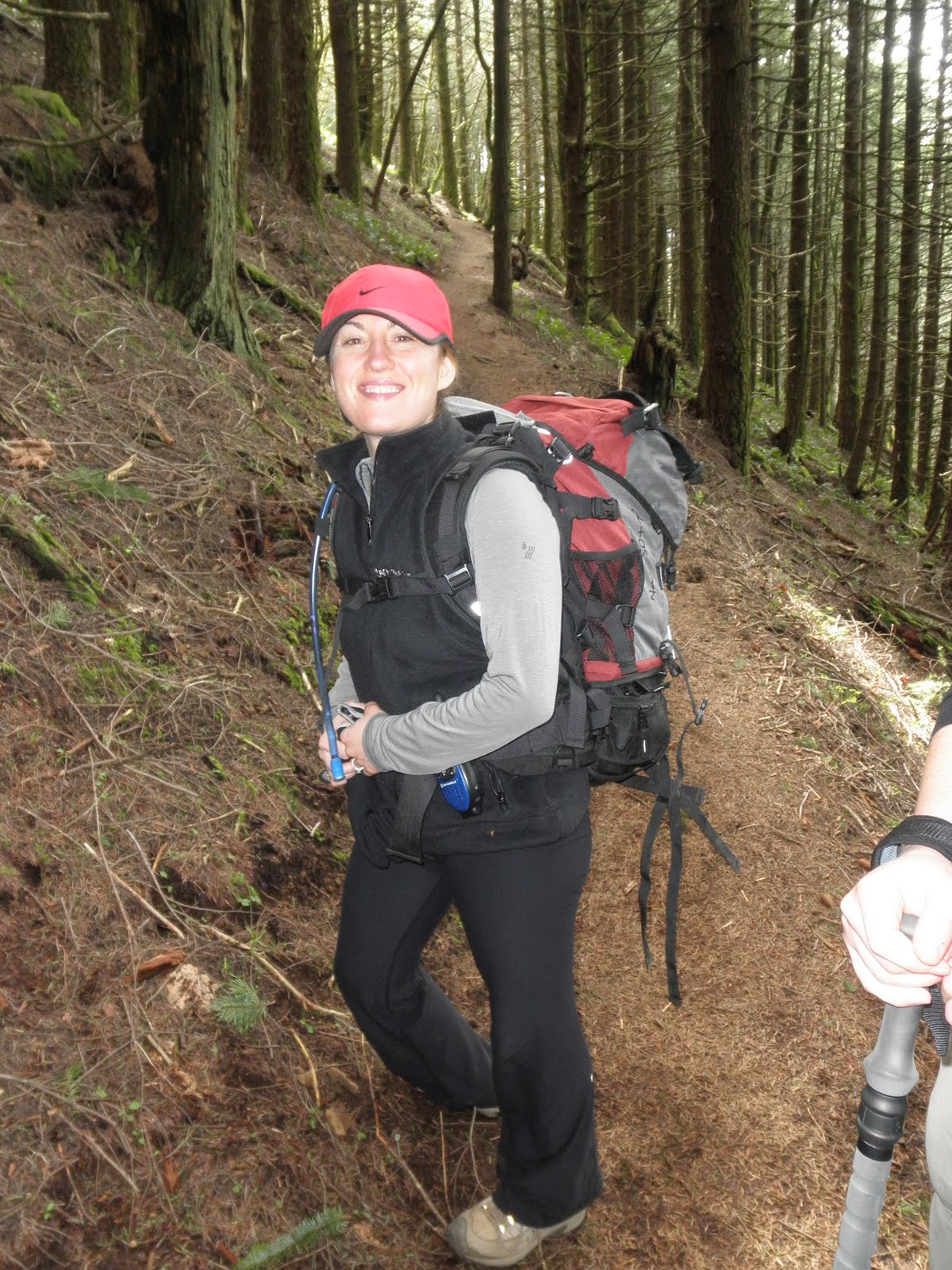
Once again, with my pack loaded to 35lbs, I joined the intermediate group led by our training leader, Kelly. From the large parking area, the trail began steeply. In several minutes into the hike, I tried to take a sip of water from my hydration tube when I realized that there was no water coming out! I thought perhaps the mouth piece was malfunctioning so I dug out the spare mouth piece and replaced it during our gear check break. Ugh, still no water!! Luckily the problem was pretty simple - somehow the tube got twisted when I put it in my back pack the night before. Thank goodness!! Though I had another bladder of water in my pack as a weight, it would have been a major hassle if I had to use that.


After gaining about 700' already in the first 1/2 mile, we came to a fork in the trail. There was a Roadrunner cartoon style sign post with two planks of wood nailed to it. One read "More difficult" that pointed to the left, and the other "Less difficult" etched on to it. Both trails before us would lead to the top after 2850 ft of elevation gain. On normal hikes, your choice would be dictated by whether you liked pain in your lungs better than in your knees or vice versa.


On any Reach The Summit hike, there was only one choice for us by default. The left fork climbed steeply up the northern flank of the mountain (the brown dotted line) with only few brief, relatively flatter sections. Though I felt like my level of fitness has regressed somewhat in the past couple of weeks as I had not been able to do much of physical exercises during that time due to some family stuff going on, I was actually surprised by how quickly we ascended this steep mountain.


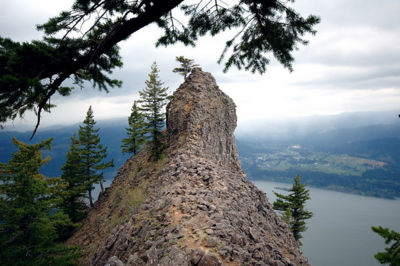
After an hour and fifteen minutes or so of pounding this wickedly steep trail, we were already popping out of the woods and were rewarded by the incredible panoramic view of the Columbia River Gorge as we emerged into the summit meadows. In fact, the view was so amazing to the point of distraction that I really had to remind myself from time to time to bring my focus back to the task of climbing at hand. At this point, we had only another 500' in elevation to go to get to the summit.


We enjoyed our lunch sitting near a small patch of snow. Mt. Hood (left) was showing off its gnarly summit blanketed in clouds behind the Gorge. Mt. St. Helens (right) was probably the most prominent of all - even though its east half had been blown off by its last eruption, it exerted its massive presence. I almost missed Mt. Adams (left) as it was sort of hidden behind the trees from where we were sitting. I couldn't wait to set my foot on it this August!


Mercifully, we descended via the "Less difficult" route that took us to the east side of the mountain that was supposed to give us a little break from having to jack hammer the dirt with our poor knees. Notice I said "was supposed to". As tough as going up was on our quads, going down was torturous to say the least. But it's true, though, that the most important part of climbing is the going down part. I was at one of the REI's seminar, "Climbing the Cascades," last night and the guy who threw the talk put it best: "The best place to be on any mountaineering trip is the parking lot."


This weekend, we are going to have tons of fun at Mt. Hood!! The guides from the Timberline Mountain Guides, who are volunteering to provide us with the technical training and guide services, are going to spend all day giving us instructions on basic mountaineering techniques. Stay tuned!!


Monday, April 12, 2010

Early Bird Special Contest Winner


And the Winner Is.... Click Here

Friday, April 2, 2010

non-RTS Training Hike - Saddle Mountain

April 2nd, 2010


Today's training hike to Saddle Mountain was postponed to 4/5 (Mon) due to hazardous weather in the area.

Stay tuned!!


April 5th, 2010

WOW, what a hike we had today!!! I was really itching to do something since I had not had a chance to hike at all for the past couple of weeks due a series of family events. On top of that, our postponing this hike due to the storm this past Friday had added to my itch like poison oak rubbing on already a raw spot.


Geoff, Charles and I met up at Target at the usual time this morning to hike Saddle Mountain. It was raining lightly when we left the Target's parking lot about 8am or so. The trail head was located about 10 miles inland from the coast near the highway 26 that ran westward from Portland. We started to see some traces of snow on the ground just as I made a remark about how we were lucky that we did not to see any snow when we were passing the 1,000' elevation marker. After driving for about an hour, we turned off onto a paved road that took us north for about another 7 miles to the trail head. After about a half way into this road, an awesome view of Saddle Mountain all of sudden appeared through the beautiful evergreen trees as we came around a curve in the road. We were the only ones in the parking lot.

So the plan was sort of to follow the regular regiment, i.e. to take a gear check break after the first 20 minutes and a break every 45 minutes or so thereafter. All three of us were dressed in layers with full rain garments that gave us protections from the elements. The trail on Saddle Mountain stretched only about 2.5 miles to the top but it gained respectable 1,700' in elevation altogether.


It was amazing how much I could go out of shape in a matter of a couple weeks though. I struggled to maintain a decent pace until we took our gear check break. But then it got much easier from there on. I guess my body needed a little jump start to get going again.


We started to see gradual increase in snow accumulation as we ascended through the wood. Little did we know that we were about to walk into a blizzard and near white out condition as we got above the tree line. The wind was blowing furiously up the side of the mountain and the trail had completely disappeared under two feet of snow in front of us. We could barely make out where it used to be.


We were at the decision point. After few minutes of observing and discussing, we decided to proceed another few hundred feet or so to see if the condition on the other side of this section would be better, or at least good enough to go further. Don't ask us why but there we went.

Where were the goggles when we needed them anyway?? We might as well have stuck our heads in front of a sand blaster actually. The wind mercilessly drove ice pellets into us like machine guns. Any exposed portion of our skin got thoroughly exfoliated in the process and, by the time we got to the other side of this section and took refuge behind a lone evergreen tree, there was no doubt in our minds that we were at the end of our little adventure for the day. Not to mention the fact that we were starting to follow a false trail (right) that led off a cliff. Great!!


After a few Kodak moments taking pictures of each other for the record, we turned around and reversed our direction to trace our foot prints back to the beginning of this section where the trees would give us some protection. To our amazement, our foot prints were almost completely gone. They had been blown over by the wind and snow to the point where we could barely see them in a matter of five to ten minutes. We proceeded step by step VERY CAREFULLY so as not to end up sliding down into an oblivion.


Even after we were back under the trees' protection, snow had accumulated as much as about a foot or so on the trail and we had to be very cautious about our footings on our descent. But the sights were gorgeous in sort of surreal ways. On one of the sections, the snow covered tree branches formed a tunnel like path for us to walk through. I had always loved hiking in snow despite its unique challenges. About a half way down the mountain, we saw another set of foot prints leading down the trail. There must have been somebody set off on a hike but decided to turn around and go back. Smart!


I had always wanted to check out Camp 18 Restaurant on highway 26 which had a lot of memorabilia from the old days in the logging industry on display in a log cabin style structure. I finally got my chance on our way back when we stopped there for a lunch. We were in awe of the purely enormous sizes of everything, such as the chain saws that were at least 10 feet in length with handles on both ends, the bar counter downstairs made of a wood slab at least two feet thick and twenty feet long, and the front register carved out of a tree stump several feet in diameter. Pretty cool.

Thursday, April 1, 2010

Climbers ascend Mount Hood in memory of woman

This article appeared on a Butte, MT paper on 3/9/10. (Click here for the link to the article.)


In 2005, Cathy Davis was a healthy wife and mother, a Boeing employee who had recently been promoted to a new position in China.

The wife of Butte resident Tom Davis, Cathy ate healthy, exercised and never smoked. And she never suspected the nagging back pain she suffered could be lung cancer.

But four months later, Davis fell victim to one of the deadliest cancers in the country, one which killed more than 160,000 Americans last year.

"It really came out of nowhere," said Tom Davis, a 1984 graduate of Butte Central, in a phone interview with The Montana Standard. "By the time Cathy knew she had it, it was too late." Tom and Cathy met at Carroll College in Helena, where she was a star athlete. They moved to Oregon, then Seattle and then to Beijing. It was there that she got sick.

For Tom it was a tough introduction to the disease, one that carries a taboo when it comes to fundraising and research efforts.

"There is this feeling like you did it to yourself, or it's your fault if you have lung cancer. Cathy never did anything, she never smoked, she ate healthy, she was very active," said Tom.

It's in memory of people like Cathy that the American Lung Association started its "Reach the Summit" program, which trains people in mountain climbing. The program includes guided trips to the summit of Mount Hood in Oregon, Mount Adams in Washington State, the Grand Tetons in Wyoming, and summits in Ecuador, including the Cayambe volcano. The climbers all raise money for the association.

Patty Unfred, of Oregon, Cathy's sister, ascended Mount Hood in 2008 as a way to honor and stay connected to her sister.

"It's hard to make sense of this kind of stuff," said Unfred. "This was a way for me to feel close to her." It wasn't something that she could imagine herself doing.

"Cathy was the athlete, not me," Unfred said with a laugh.

But she persevered with the help of her climbing group, and since conquering Mount Hood she's been motivated to continue the sport on her own.

"It really inspired me," said Unfred. "It's become a passion of mine." Alison James, Helena, development manager for the lung association's Montana and Wyoming branch, said they are still looking for people to take part in the program.

"It's a really cool adventure," said James. "Most people who join with us have never climbed before, and we will be doing a lot of training as a group." The climbs occur from June through December. The climbers are asked to raise money to take part, from $3,000 for Mount Hood to $10,000 for the South America trip.

Tuesday, March 23, 2010

5th Training Hike - Indian Point March 21st, 2010

OK, I slacked off on my blogging duties due to a series of family events for a little while but I'm back now.


Finally - Rain, mud, and more rain! Now I feel like I'm in the Northwest! However, our training continued, wet or dry. It was the first chance for us to put our wet gear to the test and to gain some experience using the equipment in real conditions. We quickly found out that it didn't really matter if our rain jackets and pants were made of super-duper high tech breathable fabrics when the humidity was 10,000%. It also revalidated the importance of adjusting our layers religiously in order to keep our temperatures in check.


We gathered to hike Indian Point, another picturesque site along the Columbia River Gorge. It was actually a big arrow shaped rock that stuck out from a point that we didn't get to see on this hike as we were feeling very wet and kind of cold by the time we got to that point and couldn't wait to get back to the car. This hike was probably the most strenuous one among all the hikes we had done so far. The trail stretched over an 8.5 miles of loop that gained over 2,700 feet all within the first third. All the hiking guide books that I had looked at suggested to proceed on the loop in the opposite direction to ours. However we were thankful that we did not do that because it would have had us landing on our behinds many times descending down the very steep, muddy and slippery surface.


But the magical thing about this area was that, even though it poured pretty much non-stop the whole time, it provided us with the views in different light through the low scuds hugging the hill sides that was just as beautiful. Too bad that I was able to take no picture on this hike except one. I was kind of looking forward to firing up and using my brand new Costco special digital camera too.


I weighed my pack to about 35 lbs again. On our previous hike, I felt that this was a reasonable load that kept me challenged without killing myself. Marty Houston led the medium group I was in this time. Because the gate to the campground behind which the trail head was located was closed at the time, we parked on the side of the road by the gate and hiked up to it. After a potty break, we set off on the trail. It gradually started up gently to the bottom of a dozen or so switchbacks. From there the trail got significantly steeper. Even though we were well covered under the tree canopies pretty much the whole time, the rain relentlessly drove down on us and we were soaked inside and out by the time we took our gear check break after 15 minutes despite the high tech rain jackets and pants that promised to keep us dry. Of course the source of the moisture was not only the rain but also the steam we generated inside the rain garments as we hustled up the trail. One positive note - my hiking boots worked wonderfully in keeping my feet dry the entire time we were walking through the muddy mess. This was good not only because our feet were the most important equipment we had but also because it kept the level of our mumbling expletives to minimum.


I kept practicing rest step throughout this whole hike and I could tell it made a measurable difference in conserving my energy. After we were back to the parking area, I really felt like I would be able to go up and do it again. Not that that would have been a good idea, as that's just the sort of situations in which I typically got injured in the past.


On our past hikes, we would typically take a short lunch break once we reached the top but we were more eager to get back to the nice dry cabins of our cars than to eat soggy sandwiches. That's OK though - we made it up by making a stop at our usual beer and burger joint.


I missed our gear clinic which I really wanted to go to and the 6th Training Hike at Kings Mountain but a couple of us are organizing hikes on our own this coming holiday weekend, as Reach The Summit has no hikes scheduled. I will be hiking Saddle Mountain on the Coastal Range so please stay tuned!

Wednesday, March 17, 2010

Online Raffle Ticket Sale!!

In an effort to reach my fundraising goal for the American Lung Association, I am having an online raffle ticket sale on the following items:
  • 1 new special made Titanium technical T-shirt (men's large, navy blue) from Columbia Sportswear Company with a Reach The Summit logo on the back. I have received this from the Reach The Summit program for reaching $500 total donation milestone and I am passing the chance to own it to you! - Minimum 3 tickets.

  • 1 new Cathedral Peak technical fleece vest (men's large, grey) from Columbia Sportswear Company I have received this from the Reach The Summit program for reaching $1000 total donation milestone and I am passing the chance to own it to you! - Minimum 3 tickets.

  • 1 unused Talus 23, a 3 season tent, from The North Face with a foot print. Click here to read about this tent. - Minimum 10 tickets.

  • 1 new signed copy of "Beyond the Limits: A Woman's Triumph on Everest" by Stacy Allison. I first met Stacy at our kickoff party in February, who was the first American woman to climb Mt. Everest. Click here to read more about Stacy Allison's incredible profile. - Minimum 5 tickets.

You can buy raffle tickets for $5/ticket until April 11th, 2010 11:59pm.

All proceeds will go to support the American Lung Association. Your name will appear in my sponsor list and you will receive a photo of me at the summit of Mt. Adams holding a special flag with your name on it among all my generous sponsors. SHOW THE WORLD YOU WENT THE DISTANCE WITH ME!!


It's easy to buy raffle tickets:

  1. Credit Card: Please Click here to go to my donation page and put in the total amount for your raffle ticket purchase. (Example: $50 if you are buying 10 raffle tickets.) In the Personal Note section, specify how many raffle tickets you want to put in for which item. (Example: "5 raffle tickets for the Columbia fleece vest") Then, click "Next" and follow the direction to complete the transaction.

  2. Check: Please make your check payable to the American Lung Association for the total amount of your raffle ticket purchase and mail to me at: Terry Tsubota, 2498 SW Schmidt Way #387, Beaverton, OR 97006. Be sure to attach a note specifying how many raffle tickets you want to put in for which item.

After April 11th, 2010, I will hold a drawing and announce the winners on this blog site!!!

For questions, please email me at HelpTerryClimb@gmail.com .

Thank you in advance and good luck!!!


Terry

Sunday, March 14, 2010

4th Training Hike - Mt Hood Govenment Camp Trails March 14th, 2010

We just kept on having the best luck on our training hikes - not warm and sunny this time!! And that's very good because we went to the southern foothill of Mt. Hood for a round of snowshoeing on this hike. There were numerous trails that meandered around the town of Government Camp covered with a blanket of fresh snow. (Click on the map on the left for a blowup of the map.) A week ago, we were all worried that there might not be enough snow and that it was going to be a muddy and miserable experience!! The condition was a lot better than we could have ever hoped for. We were to start our hike at the very western end of the Crosstown Trail, follow it up to Glade Trail, and go as high as we could until noon when we stopped for lunch.


Mercifully, the trail started this time almost flat or with very little incline if any for the first 20 minutes or so until we took our quick gear check. From there on, it got steeper and steeper as we gained elevation. It gave us a nice way to warm up and to get used to walking with those plastic planks strapped on our feet.


Almost everybody was using MSR's snowshoes which were two pieces of plastic boards with crampon teeth on the bottom and a set of bindings on the top. I had used them few time this season and had been very pleased with how they performed. The only complaints I'd had with MSR's snowshoes so far were that the bindings were not as easy to operate as, say, Tubbs' and that those plastic planks made rather loud clop clop noise. The noise issue probably wouldn't have been much of anything if only few of us were using MSR's but, when that many people were stomping on them, it made it kind of hard to have conversations at times.


But then, one of our training hike leaders, Daniel, in front of the group maintained our pace just fast enough to keep us panting at all time and therefore not yakking whole a lot anyway. I could feel that my effort to bike everyday had started to pay off a little though. Despite the increase in my pack weight from 23 lbs last time to about 35 lbs this time, and even though I was still pushing myself pretty hard, I felt like my comfort and confidence level had gone up a notch or two since we started our training hikes. I have to remember to take the side shield off my glacier glasses before our next hike as they kept fogging up every time we stopped.


In the steeper section near the end of the uphill hike, I wanted to try to practice a little a climbing technique called rest step that would give the leg muscles a momentary relief each step while climbing. I wish I could find a video clip online to show what it looks like though. Put simply, the technique goes something like this: Take a step. Straighten that leg and lock the knee. As you move to take the next step, place the weight of your entire body on the locked bone structure of your back leg. As you swing your leg forward to take the next step relax the muscles in that leg. Though our faster pace made it a little difficult to do that, it seemed to have made the slug a bit less slug like once I got the rhythm down. I am hoping that they would teach us how to do this properly when we go back to Mt. Hood for our climbing clinic in April. I have always thought this was an easy yet very effective way to conserve energy. It could make our climbs a lot more enjoyable for everyone.


By the time we took our lunch break around noon, we had gone from 3,600' at the trail head to several hundred feet below the Timberline Lodge, about 5,200' or so. One of the training hike leaders said that that was the highest they've gone on any Mt. Hood training hike. We probably started around 10:15am so that was a pretty good pace considering we were snowshoeing. We picked relatively a flat spot off the side of the trail and started devouring our lunches. My standard meal had always consisted of salami, cheese, trail mix, and dried fruits since we started training. They always tasted ten times better in the woods but I think I will try to come up with a little more variations for the future hikes. TMI: I was reminded by the dark color of my pee that I needed to increase my water intake. It's so easy to slack off on hydrating on the trail. Not good. Steve, another training hike leader and also a physician, said that he would usually drink about 8 quarts of water on a day of hiking.


We probably scared the people at the restaurant when we showed up like a pack of wild animals drawn to the smell of a wounded prey with our fangs showing and our eyes glaring. It's funny that I had never noticed this place in Government Camp though. It's not like there were much other choices. In any event, we needed to replace the calories we had just burnt and that we did. I have a feeling we will be ready to eat our own guts and ask for seconds by the time our big days come.

Friday, March 12, 2010

Making of An Outdoor Geek, Part 3

But then, why would we need any more money?? We'd got everything covered after all. Subtracting $39 ($13/person/night x 3) from the money we had, we still had 63 cents.!! It ought to be fine. Why wouldn't it??

Next, we needed to make a packing list.
  • Duffel bags (Substitute them with the "sports bags" that were popular among the grade schoolers for carrying school supplies back and forth. They were fairly water resistant too.)
  • Wool blankets (I snatched mine from the linen closet.)
  • A Tent (we didn't have one. Improvise it with ponchos if it rains.)
  • Ponchos (Funny that was fairly common back then.)
  • Change of cloths (Whatever we each had had to do it. No, no high tech $400 The North Face stuff back then.)
  • 4 days worth of food (We'd see what we could find in our respective mothers' pantries.)
  • A map (I had already "borrowed" it from the dining room in my house.)
  • Matches (There were plenty of them in my house. My dad smoked practically anything he could light.)
  • Pots and pans (I'd have to see what I could find in my mom's kitchen.)
  • The comic book (Couldn't forget that. In case we needed to refer to it for what to do.)
  • A point-n-shoot camera (I knew where my mom put hers.)
  • A rope (Not sure why we'd need it but since the kid in the comic book carried it, we'd take one.)
  • A can opener (Good idea!)
  • Flashlights & spare batteries (Self explanatory)

I think that was about it. We'd cram all this stuff in our bicycle saddle bags (Oddly, kids' bicycles in Japan back then typically came with some sorts of saddle bags that straddled the rack in the rear.) and the sports bags strapped on the back our bicycles with bungee cords.

To be continued...

Monday, March 8, 2010

3rd Training Hike - Mt. Hamilton Loop March 7th, 2010

This is getting almost unreal - great weather, sunny with scattered clouds, yet again - three weekends in a row!!! I thought this was the Northwest but we'd take all we could take!!


This time, we gathered once again to hike Mt. Hamilton loop this time. The trail started out near Beacon Rock, another picturesque site along the Columbia River Gorge on Washington side, gradually northward for few miles until a couple of series of somewhat steep switch backs took us to the top of Mt. Hamilton concluding the 2000' vertical gain. From there, we'd take the path going around and down the back side of Mt. Hamilton rejoining the lower part of the trail we went up on earlier. All together the hike was about 9 miles but many of us thought it went quicker than we had thought.

I think there were few reasons why it seemed that way. For one thing, there were so many stunning sites along the trail that had gorgeous water fall views and expansive panorama of the Columbia Gorge, letting us take our minds off the strenuousness from time to time. Also, for me, hiking with the intermediate group rather than the fast group helped me tremendously to enjoy the hike better as it didn't feel like I was in a triathlon tryout.


Nevertheless, I felt like my heart was going to pop out of my rib cage for the first 10 to 20 minutes or so until the first gear check break. Then it would get a lot easier all of sudden. In fact, I am starting to think this might be my new normal pattern. My pack weight came in at about 23 lbs this time which felt very comfortable. Note to myself - I need to add back few more pounds though. These are training hikes after all. I'd also like to think that my effort to ride my bicycle to run errands, etc. for at least an hour or so each day for the week before contributed to making some of the difference.

I also have to credit Bob, our Training Hike Leader, who was very conscious about keeping the tab on how the group was doing and judiciously stopped the group for breaks not only as our chances to catch our breaths but also as opportunities for us to practice the basic skills like taking on and off our packs, temperature control through adding or removing layers, keeping our level of hydration in check, taking small calorie intakes through out the hike, and not sitting around too long, which all might sound simple but would be important when our big days came. During one of the breaks, Eva, another Training Hike Leader hiking in our group, gave us very helpful insights on energy boosting products available on the market and also on how to use our trecking poles.


I am starting to better shape my non-hike training stuff to fit my daily schedule. So far, I have come up with plans for two of the three parts, aerobic/anaerobic training, flexibility/core strength/balance training (also injury prevention), and strength training at least to start with.


As I mentioned earlier, I started using my bicycle to go everywhere as much as possible. This has saved me from having to set aside an hour or so every day just to do aerobic/anaerobic stuff by replacing some of the time I would otherwise spend in my car. The only minor draw back, I have come to be reminded, has been that the traffic law is somewhat optional in nature to some drivers and I'd best not get flattened if at all possible. On the very first day when I took out my bicycle out for a trial run, I narrowly escaped getting T-boned by a Fast-n-Furious who sped through a stop sign with a phone buried in his ear.


Regardless of the Reach The Summit program, yoga has become an important part of my daily life in the recent months. Yoga has really helped me develop my better flexibility, core strength, and balance that are important in preventing injuries, which is as important as getting fit - it would really s#$k if I had to abort my climb after all this. In fact, it got to the point where, if I did't get to do yoga for few days, I would almost feel like I hadn't washed my hair or something for a couple of days. Bicycling a half an hour each way to and from the yoga studio has also been an added bonus. (Who thought that would ever be considered a "bonus"?)


The part I need to weave into my program is the strength training. I am toying with the idea of checking out a climbing gym as a part of it. Based on my past history, I know that I wouldn't last very long if the activities were repetitive and boring so I need to do things that are actually fun and challenging at the same time. I think trying out sport climbing would fit that category well. It would also be something new for me to do since most of my past climbing experiences were in alpine settings when I was very young. (More about this later in my series, "Making of An Outdoor Geek".) Besides, it would be something similar to what we will be doing this summer. Can anybody give me a good input on sport climbing?


As always, getting to the top was a satisfying moment for all of us accomplishing another small step towards reaching our ultimate summits. The wind was surprisingly calm and we actually had to take off the layers we had just put on not too long before. We savored the moment in this amazing weather as we chewed our lunches. 15 minutes or so later, the "endurance" group was arriving and it was time for us to start descending after our kodak moments. It's funny that it seemed like it took longer to go down than to go up - looking at the map, that might have been actually the case, in distance at least.



We congratulated ourselves afterwards at a bar/restaurant type near our meetup point with the highest caloric looking sandwiches we could find on our menus and generous pours of the locally brewed beverages for good measures.